American Catholic History
Telling the stories of Catholics on these American shores from 1513 to today. We Catholics have such an incredible history in what are now the 50 states of the United States of America, and we hardly know it. From the canonized saints through the hundred-plus blesseds, venerables, and servants of God, to the hundreds more whose lives were sho-through with love of God, our country is covered from sea to shining sea with holy sites, historic structures, and the graves of great men and women of faith. We tell the stories that make them human, and so inspiring.
Listen on:











Episodes

Friday Aug 15, 2025
Friday Aug 15, 2025
Charlene Richard was an ordinary girl in south central Louisiana. She was a typical cajun Catholic girl, good at sports, good at her studies, a devout Catholic, and known to get into a little trouble here and there, just like every other kid her age. But when she was twelve everything changed when she was diagnosed with leukemia, and died just 13 days later. How she suffered for others, and how she accepted her coming death, inspired by St. Therese of Lisieux, made all the difference for “the Little Cajun Saint.”

Tuesday Aug 05, 2025
Tuesday Aug 05, 2025
"Stagecoach" Mary Fields was a hard-drinking, gun-toting, street-brawling black woman in the Montana frontier. She also was a kind-hearted guardian to the children of the Montana frontier, including native children, and she was a dear friend to the Ursuline nuns who had set up a mission near Cascade, Montana. In spite of her hard work, dedication to those in need, and generosity, she was treated poorly by those in positions of power. She spent eight years as a mail carrier running a Star Route in Montana. She was good at it, but some were upset by how good she was at it and gave her the nickname "Stagecoach Mary" as a way to denigrate her service. After leaving the Star Route she took on other jobs to make ends meet. While some resented her abilities, most loved her and appreciated her generosity and hard work. When she died in 1814 her funeral was one of the largest that Cascade, Montana had ever seen.

Wednesday Jul 23, 2025
Wednesday Jul 23, 2025
Shrines dedicated in honor of St. Anne are among the oldest Catholic establishments in the U.S. St Anne de Detroit, for instance, is the second-oldest parish in the United States, while the shrine on Isle la Motte, Vermont, was part of a French fort protecting the southern approaches to Montreal. Some shrines have dramatic stories, like the National Shrine of St. Anne in Scranton, Pennsylvania which nearly collapsed due to mining activity in the hill beneath it. Most have a relic of St. Anne, the grandmother of Jesus. The Shrine of St. Anne in Fall River, Massachusetts was built to rival the great shrine of St. Anne de Beaupre in Quebec, but demographic changes brought that awe-inspiring structure nearly to the point of demolition. These shrines often arose where French and French Canadians settled, as the French have historically had a deep devotion to the mother of Mary and grandmother of Jesus.
Image credits: St. Anne de Detroit, creative commons license, Polonia90; St. Anne's Church and Parish Complex, Fall River, Massachusetts, creative commons license, Kenneth C. Zirkel
Monday Jul 14, 2025
Monday Jul 14, 2025
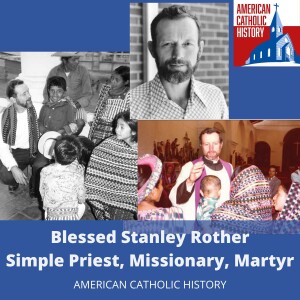
Stanley Rother was born in Okarchee, Oklahoma the oldest of four children to a family of Catholic German farmers. He grew up learning the ways of farming, playing sports, and serving Mass. He entered seminary but struggled with some theology classes and Latin. The seminary eventually sent him home saying he wasn't priest material. Fortunately his bishop and Mount St. Mary's Seminary in Emmitsburg, Maryland wanted to give him another chance. He graduated and was ordained a priest for Oklahoma City-Tulsa in 1963. In 1968 he requested to be a missionary in Santiago Atitlan, Guatemala where the Diocese had a mission. He went and learned both Spanish and the difficult Tzutujil language of the small community of native peasants among whom he served as a missionary. He poured himself into the work, eventually translating the Mass and even the New Testament into Tzutujil. He also worked to bring modern farming techniques to the community and taught math along with language and catechetical lessons. His efforts, however, made him a target of both the government and left-wing militant groups who were fighting a bloody civil war that lasted decades. A number of his parishioners were victims of the Civil War as they refused to cooperate with either side of the fight. Father Rother wrote that "the shepherd doesn't flee at the first sign of danger." Eventually he was found to be number 8 on a death list, so his bishop ordered him to return to Oklahoma. He spent a few months at his family farm, but eventually requested permission to return to Santiago Atitlan to be with his people for Easter. He returned in April 1981, but on July 28, 1981 he was gunned down in the rectory in the middle of the night. He was regarded as a martyr and a great man from immediately after his death. His body was returned to Oklahoma, but his heart was returned to Santiago Atitlan where it remains. His cause for canonization opened in 2010, and he was beatified in a large outdoor Mass in Oklahoma City in 2017. A large shrine dedicated to Blessed Stanley Rother opened in 2023 in Oklahoma City.
Thursday Jul 10, 2025
Thursday Jul 10, 2025
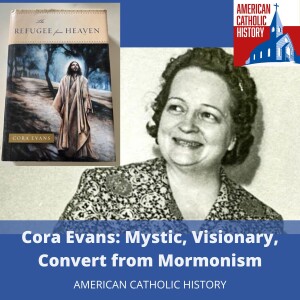
Cora Evans grew up a good Mormon, but had a crisis of faith during her wedding at the Mormon Temple in Salt Lake City. She and her husband left the Mormon faith, and eventually became Catholic. This led to hardships as they were shunned for their apostasy. They had to flee Utah for California where they lived the rest of their lives. Cora's conversion came about in part because she had been having visions of the Blessed Mother since she was very young, but it wasn't until she spoke with a Catholic priest when she was 30 that she realized who this "beautiful lady" who visited her was. Her mystical experience grew in intensity, and eventually included many visits by Jesus himself, whom she alwasy called "The Master." Jesus gave her the mission of spreading devotion to the "Mystical Humanity of Christ," and he charged her to write and document her experiences. She had never written much, and wasn't highly educated, but she was obedient and she wrote about what Christ revealed to her. Her experiences came to the attention of the Church in Los Angeles, and the archbishop had Jesuits and other priests visit her to test the authenticity of her visions. Her responses and understanding convinced the experts and the archbishop that her visions were genuine, but that they were private revelations, not to be publicized at least during her lifetime. Eventually her writings filled boxes and boxes worth of manuscripts about her experiences. Some have been published, including one published under the title Refugee from Heaven. Those who carry on her work still offer conferences and retreats to help people live a life according to the Mystical Humanity of Christ. In 2010 her cause for canonization was officially opened, giving her the title of Servant of God.
Monday Jul 07, 2025
Monday Jul 07, 2025
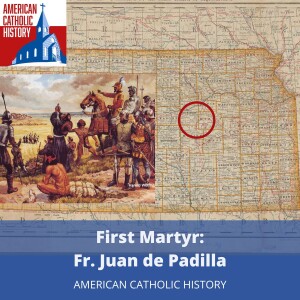
Franciscan Fr. Juan de Padilla accompanied Coronado on his 1541 mission into New Mexico to search for the legendary Seven Cities of Gold. Father Padilla was looking for souls to evangelize and save. After Coronado’s search was frustrated, Fr. de Padilla remained behind to evangelize natives among the Ouichita — or Wichita — in modern day Kansas. Details aren't clear as to how or precisely where, but for his efforts he was the first to shed his blood for Christ in the New World. Three different markers in modern day Kansas mark places where his martyrdom could have happened. All three are within 100 miles of the geographic centerpoint of the contiguous 48 states. His martyrdom happened about 100 years prior to the first of the North American Martyrs in New York.
Monday Jun 30, 2025
Monday Jun 30, 2025
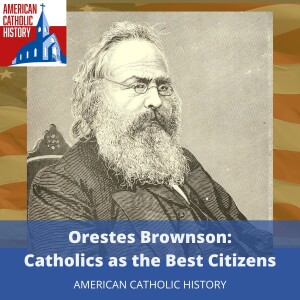
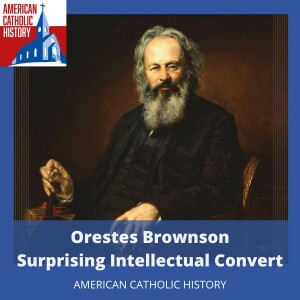
Orestes Brownson was the first major American Catholic intellectual to gain an international reputation. His thinking on the significance of America, and the place of Catholics within American political life was new and unexpected. He believed, contra what many anti-Catholics in his day believed, that not only could Catholics be good Americans, but that Catholics could be the best Americans. He also had strong opinions on slavery. Brownson opposed slavery as a great evil, but he was not an abolitionist. He believed that those who held slaves had a moral obligation to treat them well, and to prepare them to be free men and women, but that simply freeing all slaves would bring about great harm to the slaves as well as society. But once the Civil War began, he became an abolitionist, believing that, since the South made the war about the right to own slaves, slavery must be ended as part of the North’s victory in the Civil War.
Friday Jun 27, 2025
Friday Jun 27, 2025
Orestes Brownson was a major intellectual of the 19th century, and a Catholic convert in his 41st year. Born in 1803 in Vermont, he was raised Christian, but in no particular Christian denomination or sect. He was largely self-taught, and had a strong sense that one must follow reason to arrive at truth, no matter where it was found. In his teens he began a struggle for religious truth that would start in Presbyterianism, then through Universalism, and Unitarian Transcendentalism, before he finally became Catholic, and remained so for the remaining three decades of his life. This is part one of a rare two-part treatment of a topic.
Monday Jun 23, 2025
Monday Jun 23, 2025
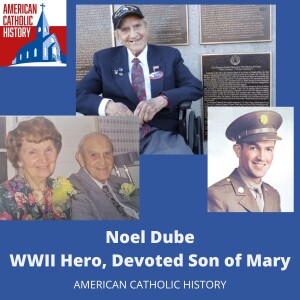
Noel Dubé, Noëlle’s grandfather, was a hero of World War II, landing on D-Day and playing a key role in the breakout from the beaches and the race through the hedgerows of Normandy. He also raised ten children with his wife Toni and started a local shrine to Our Lady which drew thousands of visitors annually from across the country. His devotion to Mary began at a young age when his mother died and he took Mary to be his mother.
Thursday Jun 19, 2025
Thursday Jun 19, 2025
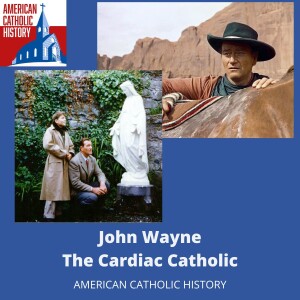
John Wayne, the icon of American manliness and one of the most important film stars of all time, once called himself a "cardiac Catholic." He meant that he intended to become Catholic on his deathbed. Born Marion Morrison he was raised a Presbyterian, but all three of his wives were Catholic. We're not sure how that worked out, since none of them predeceased him, but we leave that to God's grace and the wisdom of the Church. However, the example of many Catholics in his life, particularly his first wife, had a deep impression on him. Despite serious problems with infidelity, John Wayne did manage to become Catholic and make his amends with God before his death.